
Have you ever thought about running an online advertising campaign but felt unsure about how much money you should spend? You’re not alone. Many small business owners, online sellers, and beginners face the same challenge. Everyone wants more visitors, potential customers, and sales without wasting money on ads that don’t deliver the expected results. The good news is that you don’t need to be an advertising expert to start planning your budget. With a clear goal, a basic understanding of advertising costs, and a little preparation, you can make smarter decisions before launching your campaign.
In today’s blog, we’ll discuss how to plan your YouTube advertising budget and overall ad campaign budget, understand the important advertising metrics, and explore a simple example of estimating clicks and costs. We’ll also cover common budgeting mistakes and practical ways to get more value from your advertising spend. Whether you’re promoting a new online store, growing a small business, or learning digital marketing for the first time, this guide will help you plan your next campaign with greater confidence.
What Is an Advertising Campaign?
An advertising campaign is a planned effort to promote a product, service, website, or brand to a specific audience. Businesses use campaigns to reach potential customers, attract website visitors, generate leads, increase sales, or introduce something new to the market.
Today, you can run advertising campaigns on platforms such as Google Ads, Facebook, Instagram, YouTube, and other digital advertising networks. Each platform offers different ways to reach people, depending on their interests, search activity, location, and behavior.
For example, imagine you’ve recently launched an online store selling home accessories. You might use Google Ads to reach people searching for particular products, while Instagram ads could help introduce your products to people who may be interested in them.
Both approaches can be useful, but they may produce different results and costs.
That’s why it’s important to think about your campaign goal before deciding how much to spend. More website visitors aren’t always the same as more customers, and a large advertising budget doesn’t automatically guarantee better results.
Why Is Ad Budget Planning Important?
When you’re spending your own money on advertising, every decision matters. Planning your budget helps you understand your limits, set realistic expectations, and decide what you want to achieve.
Here are a few reasons why it deserves your attention before you launch a campaign.
It helps you avoid overspending
It’s easy to increase your advertising budget when you want faster results. However, spending more without understanding your campaign performance can put unnecessary pressure on your finances.
Start with an amount you can afford to test. This gives you an opportunity to learn how your campaign performs without committing too much money at the beginning.
It helps you set realistic goals
Suppose your goal is to attract visitors to your website. Your planning may focus on estimated clicks and the cost of bringing people to your site.
If your goal is to generate sales, you’ll also need to consider conversion rates, profit margins, and the cost of acquiring customers.
Knowing your goal makes it easier to choose which numbers to track.
It makes budget comparisons easier
What happens if you increase your budget from $100 to $200? How many additional clicks might you receive if your average cost per click stays the same?
You can use simple calculations to compare these scenarios. The results won’t predict exactly what will happen, but they can help you understand the possible outcomes of different spending decisions.
It helps you measure what matters
Without a plan, you might focus only on how many people clicked your ad. But clicks alone don’t tell the whole story.
You should also consider whether those visitors completed your desired action, such as making a purchase, submitting a form, or contacting your business.
A useful advertising budget is one connected to a clear business objective.
What Is an Ads Campaign Calculator?
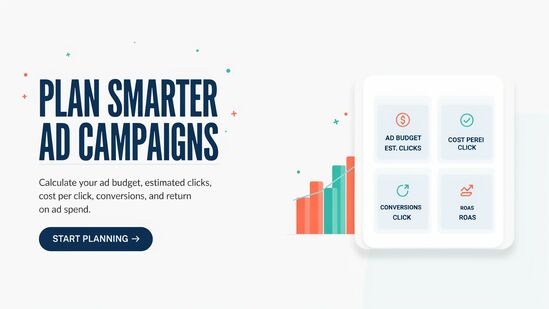
An Ads Campaign Calculator is an online tool that helps you estimate advertising costs or potential campaign results using the figures you provide. Depending on its features, it may help you work out estimates related to your budget, clicks, impressions, or other advertising metrics.
At ToolZin, our goal is to make everyday digital tasks simpler by providing useful online tools that people can use without unnecessary complications.
If you’re preparing an advertising campaign, you can try our Ads Campaign Calculator to explore estimates using the inputs supported by the tool.
Instead of working through every calculation manually, you can use the calculator to help organize your planning. You can also adjust your inputs to compare different scenarios before deciding how to approach your campaign.
Remember, a calculator supports your decision-making; it doesn’t replace real campaign data or guarantee advertising results.
How to Calculate an Advertising Budget
You don’t need a complicated strategy to begin planning your first campaign. Start with a few basic questions, then use the answers to build a reasonable starting budget.
Start by choosing your campaign objective
Before thinking about money, decide what you want your advertising to achieve.
Are you trying to bring more people to your website? Do you want to generate leads for your service? Are you hoping to sell products through your online store?
Your answer will influence the metrics you need to measure.
For example, a campaign designed to attract website traffic may focus on clicks and cost per click. A sales campaign needs a closer look at conversions, customer acquisition costs, and revenue.
Try to choose one primary objective for each campaign. It will make your results easier to understand.
Decide how much you can afford to spend
Next, determine the amount you’re comfortable investing in your campaign.
If you’re a beginner, it can be helpful to start with a small, controlled test rather than committing a large amount immediately. The right amount depends on your finances, business goals, product margins, and the platform you’re using.
You should also decide how long the campaign will run. A daily budget and a total campaign budget are not the same thing, so make sure you understand how your chosen advertising platform charges and manages spending.
For example, you might plan a total budget of $150 for a short test. You could then compare your results against your original goal and decide whether further testing makes sense.
This is an illustrative budget, not a recommendation that $150 is suitable for every business.
Estimate clicks and advertising costs
If your campaign uses a cost-per-click model, you can estimate the number of clicks your budget might support.
The basic formula is:
Estimated clicks = Advertising budget ÷ Average cost per click
Suppose your budget is $100 and your assumed average cost per click is $0.50.
Your calculation would be:
$100 ÷ $0.50 = 200 estimated clicks.
This means your budget could support approximately 200 clicks if the average cost per click remains at $0.50 and the full budget is spent under those assumptions.
In a real campaign, your actual number of clicks may be higher or lower. Costs can change depending on competition, audience targeting, ad quality, location, and other factors.
Review the results against your goal
Once you’ve calculated your estimates, ask yourself whether they make sense for your objective.
If you’re planning a traffic campaign, consider whether the estimated number of visitors is useful for your website. If you’re aiming for sales, think about how many visitors might convert and whether the potential revenue could justify the cost.
You should avoid assuming that every click will turn into a customer. Some visitors may leave immediately, while others may browse without purchasing.
Your first calculation is a planning starting point. Actual campaign data will help you make better decisions over time.
Important Advertising Metrics to Understand
Digital advertising comes with several terms that may seem confusing at first. Understanding the most relevant ones can help you read campaign reports and make more informed budget decisions.
Cost per click (CPC)
CPC stands for cost per click. It tells you how much you pay for an individual click in a cost-per-click advertising campaign.
For example, if you spend $60 and receive 120 paid clicks, your average CPC is:
$60 ÷ 120 = $0.50 per click.
CPC can help you understand how much you’re paying to bring visitors to your website. However, a low CPC doesn’t automatically mean a campaign is successful. The quality of those visitors and the actions they take also matter.
Cost per thousand impressions (CPM)
CPM represents the cost of one thousand ad impressions. An impression generally means that an ad was displayed, according to the platform’s measurement rules.
The basic formula is:
CPM = (Advertising cost ÷ Impressions) × 1,000
For example, if a campaign costs $40 and generates 10,000 impressions, the CPM is $4.
This metric can be helpful when comparing campaigns designed to increase brand awareness or reach an audience.
Cost per acquisition (CPA)
CPA measures how much you spend to generate a defined acquisition or conversion, such as a purchase or qualified lead.
Suppose you spend $200 on a campaign and receive 10 purchases attributed to that campaign. Your cost per purchase would be $20.
That number becomes more useful when you compare it with your profit per sale. A $20 acquisition cost might be acceptable for one business but too expensive for another.
Always define the action you’re measuring so that your comparisons remain meaningful.
Click-through rate (CTR)
CTR shows the percentage of impressions that resulted in clicks.
The formula is:
CTR = (Clicks ÷ Impressions) × 100
If your ad receives 100 clicks from 5,000 impressions, the CTR is 2%.
CTR can help you understand whether people are responding to your ad, but it doesn’t tell you everything about its effectiveness. A campaign may receive plenty of clicks without generating many sales.
Return on ad spend (ROAS)
ROAS compares the revenue attributed to advertising with the amount spent on that advertising.
The formula is:
ROAS = Advertising revenue ÷ Advertising spend
For example, if you spend $100 on ads and generate $400 in attributed revenue, your ROAS is 4, often written as 4:1.
This means the campaign generated $4 in attributed revenue for every $1 spent on advertising.
However, ROAS isn’t the same as profit. Product costs, shipping, payment fees, taxes, returns, and other expenses can reduce what your business actually earns.
For that reason, always look at your wider business costs before deciding whether a campaign is profitable.
A Simple Example of Advertising Budget Calculation
Let’s imagine you’re running a small online store and want to estimate how many website visitors a campaign might bring in.
You decide to test a budget of $150. Based on your planning assumptions, you estimate an average cost per click of $0.75.
Here’s how the calculation works:
- Planned advertising budget: $150
- Assumed average CPC: $0.75
- Estimated clicks: $150 ÷ $0.75
- Estimated result: 200 clicks
Under these assumptions, your campaign could generate approximately 200 clicks if the budget is fully spent at that average CPC.
But what could those clicks mean for your store?
Let’s add another hypothetical assumption: 2% of those visitors make a purchase. Two percent of 200 clicks would equal approximately four purchases.
This is only an illustration of how conversion assumptions affect planning. It isn’t a prediction that your campaign will generate four sales.
Your actual results will depend on factors such as the products you’re selling, your pricing, audience relevance, website experience, and checkout process.
You can use this kind of example to explore different scenarios. What happens if your average CPC increases? What if fewer visitors make a purchase? What if you improve your landing page and more visitors convert?
Changing one assumption at a time can help you understand how sensitive your plan is to different outcomes.
Common Advertising Budgeting Mistakes to Avoid
Even a carefully planned campaign can run into problems. Being aware of common mistakes can help you prepare and make more thoughtful decisions.
Expecting guaranteed results
Advertising estimates are useful, but they aren’t promises. Your actual costs and results may change as the campaign runs.
Use calculations to establish expectations, then compare those expectations with real performance data.
Ignoring the cost of conversions
A campaign that attracts inexpensive clicks may still struggle to generate sales. If your business goal is to sell products, pay attention to the cost of acquiring customers rather than focusing on traffic alone.
You should also compare acquisition costs with the profit you earn from each sale.
Making changes too quickly
It’s natural to feel concerned when a new campaign doesn’t perform as expected. However, making frequent changes before you have enough relevant data can make it difficult to understand what’s working.
At the same time, don’t leave a campaign running without monitoring it. Set reasonable review points and make adjustments based on your goals, budget limits, and the amount of data available.
Forgetting to track results
Without tracking, you may know how much you spent but not whether that spending helped your business.
Where appropriate, use conversion tracking, analytics, and the reporting tools provided by your advertising platform. Check that the events you measure reflect meaningful actions for your business.
Spending more without understanding why
Increasing your budget may help a successful campaign reach more people, but it can also increase losses if the campaign isn’t working well.
Before increasing spending, review your results and consider whether your costs, conversion rate, and business margins support that decision.
Tips to Get More From Your Advertising Budget
You don’t always need a bigger budget to improve your advertising approach. Sometimes, better planning and more careful testing can help you use the money you already have more effectively.
Test your campaign before scaling
When possible, start with a manageable test that gives you useful information about your audience, ads, and landing page.
Use the results to identify what needs improvement before considering a larger investment. Make sure your test budget and duration are appropriate for the goal and the amount of data you need.
Reach the right audience
Your ads should be relevant to the people most likely to be interested in your product or service.
Think about your target customers, their needs, the locations you serve, and the problems your offer solves. Broad targeting isn’t always better, and overly narrow targeting may limit your reach.
Use your campaign data to understand which audiences respond best.
Improve your landing page
Getting someone to click your ad is only part of the process. When visitors arrive on your website, they should be able to understand your offer and take the next step without unnecessary difficulty.
Make sure your page loads properly, works well on mobile devices, explains your product or service clearly, and has an obvious next action.
For an online store, clear product details, transparent pricing, shipping information, and a smooth checkout process can all help improve the customer experience.
Monitor meaningful metrics
Choose metrics that match your campaign goal. If you want website traffic, CPC and CTR may be useful. If you want sales, pay closer attention to conversions, CPA, revenue, and profitability.
Don’t judge your entire campaign by a single number. A good decision usually comes from looking at several relevant measures together.
Review and adjust your budget regularly
Set a schedule to review campaign performance. Compare your actual spending and results with your original plan, and document what you learn.
If the campaign isn’t meeting your goals, investigate the possible reasons before spending more. If it’s performing well, consider whether additional spending is financially sensible and likely to support your objectives.
Frequently Asked Questions
What is an Ads Campaign Calculator?
An Ads Campaign Calculator is an online tool that helps you estimate advertising costs or potential campaign results using the information you enter. The exact estimates depend on the calculator’s features and supported inputs.
How do I calculate an advertising budget?
Start by choosing a campaign goal and deciding how much you can afford to spend. Then estimate relevant costs, such as CPC or CPM, and determine which results you want to measure. Review actual performance as your campaign runs.
How much should a small business spend on advertising?
There isn’t one budget that works for every business. Your budget should reflect your available funds, business goals, profit margins, competition, and ability to measure results. If you’re new to advertising, consider a controlled test you can afford.
How can I estimate clicks from an advertising budget?
Divide your advertising budget by your assumed average cost per click. For example, a $100 budget at an average CPC of $0.50 would support an estimated 200 clicks. Actual results may differ.
What is the difference between CPC and CPA?
CPC measures the cost of a click, while CPA measures the cost of a defined acquisition or conversion. CPC helps you understand traffic costs; CPA helps you understand how much you’re spending to achieve a particular action.
Can an Ads Campaign Calculator predict exact results?
No. A calculator can provide estimates based on your inputs and its formulas, but it cannot guarantee actual clicks, conversions, or revenue. Real results depend on your campaign, audience, competition, website, and other factors.
How can I improve my advertising campaign performance?
Start by setting a clear objective, targeting a relevant audience, creating useful ads, and providing a good landing-page experience. Track the metrics that matter to your goal and make changes based on actual data.
Is a low cost per click always better?
Not necessarily. Lower CPC can make website traffic less expensive, but the visitors also need to be relevant to your goal. A campaign with a higher CPC may still be worthwhile if it attracts more valuable customers at a sustainable acquisition cost.
What is the difference between ROAS and profit?
ROAS measures attributed advertising revenue relative to advertising spend. Profit accounts for additional costs, such as product expenses, shipping, fees, and other business overheads. A high ROAS does not automatically mean your business is profitable.
Final Thoughts
Planning an advertising campaign becomes easier when you understand your goals, set a realistic budget, and know which numbers to watch. You don’t need to predict every result perfectly before you begin. What matters is starting with a sensible plan, measuring what happens, and learning from the information you collect.
Use estimates to compare different budget options, but remember that real campaign data should guide your decisions over time. Be patient with the learning process, keep your spending within limits you can afford, and focus on the results that matter to your business.
If you’re preparing your next campaign, try the ToolZin Ads Campaign Calculator to work through the estimates supported by the tool and make your budget planning a little easier.
One question for you: When planning an advertising campaign, what feels most difficult — deciding how much to spend, estimating the number of clicks, or understanding whether your ads are actually profitable? Share your thoughts in the comments. Your experience may help someone else who is learning how to advertise online.